Rabbi Yoḥanan said: ‘What is the meaning of the verse, “Happy is the person who fears always, but one who hardens the heart will fall into evil” (Proverbs 28:14)? Jerusalem was destroyed because of Kamtza and Bar Kamtza.’
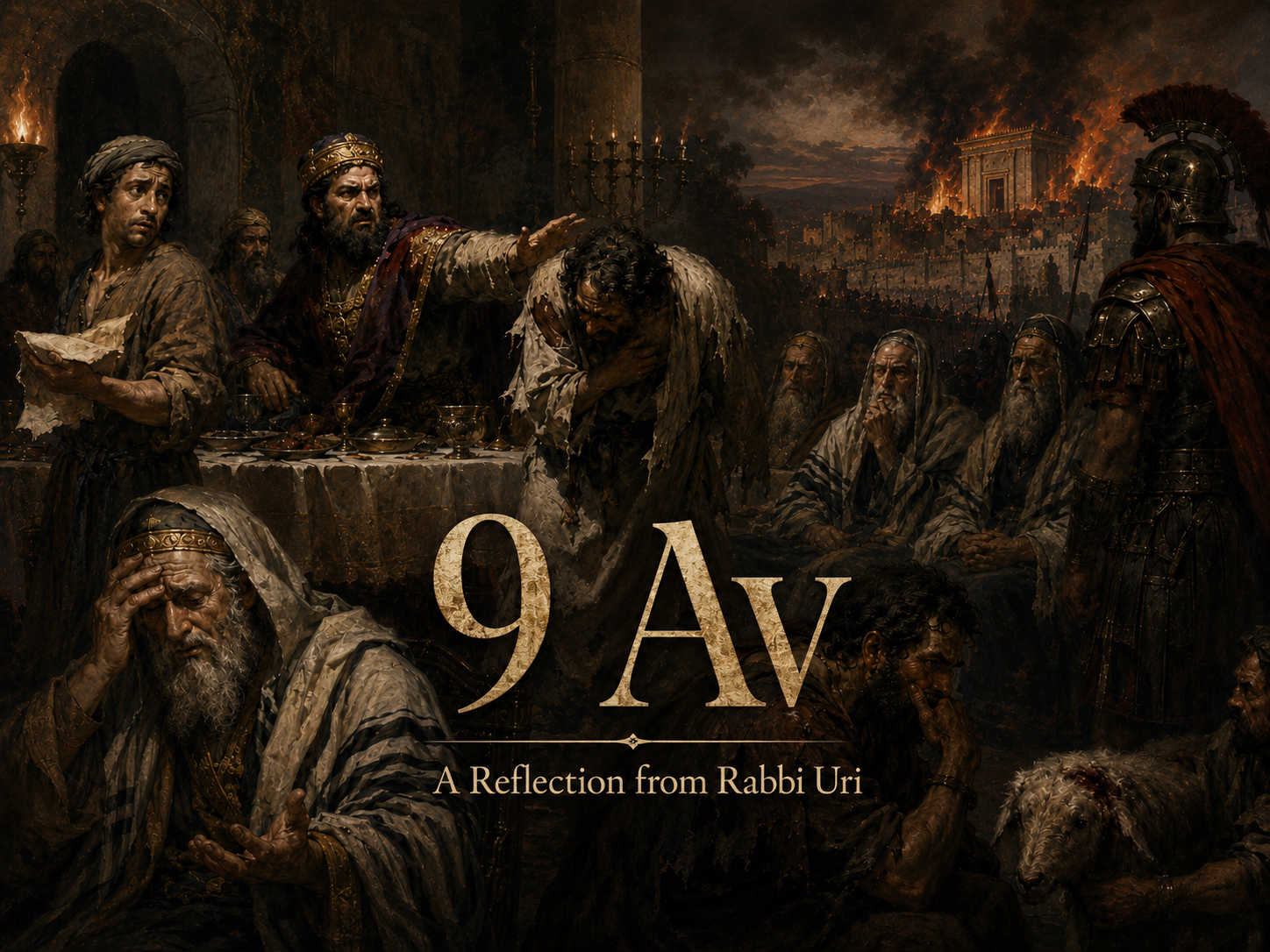
A certain man in Jerusalem had a friend named Kamtza and an enemy named Bar Kamtza. One day, he prepared a banquet and told his servant: ‘Go and bring Kamtza.’ The servant made a mistake and brought Bar Kamtza instead. When the host saw Bar Kamtza sitting at his table, he said to him: ‘You are my enemy. What are you doing here? Get up and leave.’ Bar Kamtza replied: ‘Since I am already here, let me stay, and I will pay for whatever I eat and drink.’ The host refused. Bar Kamtza said: ‘Then let me pay for half of the entire banquet.’ The host refused again.Bar Kamtza said: ‘Then let me pay for the whole banquet.’ Still, the host refused. He took Bar Kamtza by the hand, stood him up, and threw him out.
Bar Kamtza said to himself: ‘Since the Sages were sitting there and did not protest, they must have approved of what happened.’ Filled with humiliation and anger, he went to the Roman authorities and told them that the Jews were rebelling. The Romans sent an animal as an imperial offering to be sacrificed in the Temple. On the way, Bar Kamtza secretly made a blemish on the animal, in a place that rendered it unfit according to Jewish law, though it would not be considered a defect by Roman standards. The Sages debated what to do. Some suggested sacrificing the animal anyway for the sake of peace with the government. Rabbi Zechariah ben Avkolas objected: ‘People will say that blemished animals may be offered on the altar.’ Others suggested taking drastic action against Bar Kamtza so he could not inform the authorities. Rabbi Zechariah objected again: ‘People will say that one who blemishes a consecrated animal is liable to death.’ Rabbi Yoḥanan then concluded: ‘The humility, or excessive scrupulousness, of Rabbi Zechariah ben Avkolas destroyed our Temple, burned our Sanctuary, and exiled us from our land.’” (b. Gittin 55b–56a)
This is one of the most haunting rabbinic stories connected with Tisha B’Av. At first glance, it is not a story about armies, flames, siege, famine, or imperial violence. It is a story about a party.
Was Jerusalem really destroyed because of Kamtza and Bar Kamtza? Of course not. Historically, it was the Romans who destroyed Jerusalem and burned the Second Temple in the year 70 CE. But the Rabbis rarely allow us to place all blame outside ourselves. They know Rome destroyed the building. Still, they ask a deeper and more painful question: What had already broken inside Jewish society? What moral, spiritual, and political failures made the destruction possible?
The story is brief, but it is a masterpiece of moral diagnosis. It does not give us one villain. It gives us a chain of failures.
- The Messenger: Carelessness
The first person responsible is the messenger. He makes a mistake. An innocent mistake, perhaps. No hatred. No malice. Just a wrong invitation.
Rabbi Yoḥanan introduces the story with the verse: “Happy is the person who fears always.” This does not mean living in fear or paranoia. It means living with awareness, caution, and humility. Human beings make mistakes. Communities make mistakes. Institutions make mistakes. Sometimes very large tragedies begin with very small acts of carelessness: a name confused, a message sent to the wrong person, a moment handled on autopilot.
The first lesson is simple and difficult: do not live on autopilot. Our words, assumptions, and small actions can have consequences much larger than we imagined.
- The Host: Exclusion
The second responsible figure is the host. The story never gives us his name. We do not know why he loved Kamtza or why he hated Bar Kamtza. But we know what defines him: he is closed.
There is a linguistic beauty here. The word Kamtza may mean “grasshopper” in Aramaic, but it also echoes the Hebrew root associated with closing or grasping. In modern Hebrew, a kamtzan is a miser, a stingy person. Kamtza can therefore become a symbol of the closed hand, the closed heart, the closed table, and the closed community.
The host sees Bar Kamtza at his party and cannot tolerate his presence. Even when Bar Kamtza offers to pay for his own meal, then half the banquet, then the entire banquet, the host refuses. He would rather lose money than allow his enemy to save face.
Societies begin to collapse when those who feel like the “owners of the party” decide who belongs and who does not.
- Bar Kamtza: Revenge
The third responsible figure is Bar Kamtza.
Kamtza is mentioned, but he never appears. He never receives the invitation. The one who comes is Bar Kamtza. Why did he come? Did he come simply to provoke the host? Did he think the invitation was a gesture of reconciliation? Should he have left earlier? Should he have insisted so much? And above all: should he have taken revenge?
Bar Kamtza represents someone who feels humiliated, excluded, and discriminated against. His pain is real. But instead of finding a healthy way to channel that pain, he chooses revenge. He turns a personal wound into a national disaster. The story does not deny his humiliation, but it does not excuse his response. Pain is real; revenge is still a choice.
- The Sages: Silence
The fourth group responsible is perhaps the most painful one: the Sages.
They were there. They did not throw Bar Kamtza out. They did not create the conflict. They did not humiliate him directly. But they watched, and they remained silent.
That silence is not a minor detail. It is the turning point. Bar Kamtza says explicitly that because the Sages did not protest, they must have approved. In a moment of public humiliation, neutrality does not exist. Silence becomes a form of participation.
The Rabbis are teaching us that societies are not destroyed only by cruel people. They are also destroyed by good people who become furniture in the room.
- Rabbi Zechariah ben Avkolas: Failed Leadership
The fifth responsible figure is Rabbi Zechariah ben Avkolas.
He is not evil. He is not corrupt. He is not cruel. In fact, he seems deeply committed to the integrity of Jewish law. But he is not equal to the moment.
Every option presented to him carries risk, and he refuses them all. When the Sages consider sacrificing the Roman offering in order to avoid danger, Rabbi Zechariah says no: people may learn the wrong halakhic lesson. When they consider taking drastic action against Bar Kamtza, he also says no: people may learn the wrong legal precedent.
Technically, he has arguments. But the Talmud’s judgment is devastating: his excessive humility, or excessive scrupulousness, destroyed the Temple, burned the Sanctuary, and exiled the people from the land.
The point is not that law does not matter. The point is that leadership requires more than technical correctness. There are moments when a leader must see the whole picture, assume responsibility, and make a painful decision. Sometimes one can be right in every detail and wrong in the totality.
Final Ideas
This is why the story of Kamtza and Bar Kamtza remains so powerful before Tisha B’Av. Rome destroyed the Temple, but the Rabbis ask us to look at the banquet. Because before a sanctuary burns, a table can become cruel. Before a city falls, a community can lose its compassion. Before exile begins, people can stop seeing one another.
Tisha B’Av is not only a day to mourn what happened to us. It is a day to ask what happens among us. Where are our closed tables? Who is being humiliated while others remain silent? When does our pain become destructive? When does our caution become an excuse not to lead?
Jerusalem was not destroyed in one day. It was destroyed every time someone was careless, every time someone closed a door, every time someone chose revenge, every time good people stayed silent, and every time leaders were too afraid to lead.
The question before Tisha B’Av is not only who destroyed Jerusalem then. The question is what we are doing now to make sure we do not repeat the same story.
Nechama,
Rabbi Uri