No Jews Among the Founders, Yet Jewish Ideas at the Founding
A Fourth of July/Shabbat Reflection on America’s Fifth Jubilee
This Shabbat coincides with an extraordinary moment in American history. As our nation marks the 250th anniversary of the Declaration of Independence—five biblical Jubilees since its founding—we are invited not only to celebrate, but also to reflect. Anniversaries of this magnitude are opportunities to ask not merely how a nation was born, but what ideas gave it life and continue to sustain it.
One of the most enduring symbols of those ideals is the Great Seal of the United States. Every American recognizes it: the bald eagle at its center, thirteen stars overhead, an olive branch in one talon and arrows in the other, all gathered beneath the familiar motto, E Pluribus Unum—“Out of many, one.” It appears on our official documents, government buildings, passports, and every one-dollar bill. No Jew participated in its design, nor did any Jew stand among the Founding Fathers. Yet it is difficult to contemplate this emblem without recognizing how deeply the moral imagination of the Hebrew Bible had already entered the intellectual world from which the American Republic emerged.
The eagle, for example, immediately evokes one of the Torah’s most powerful images. Before the revelation at Sinai, God tells Israel, “I carried you on eagles’ wings and brought you to Me.” In Jewish tradition, the eagle is not merely a symbol of strength but of protection. The Midrash imagines the eagle carrying its young above its wings, willing to receive the arrow before allowing harm to reach its children. Whether or not this reflects ornithology is beside the point. It reflects theology. Power exists, first and foremost, to protect the vulnerable.
The eagle also grasps two seemingly opposite symbols: an olive branch and a bundle of arrows. The tension is unmistakable. A nation must be prepared to defend itself, yet its gaze should always remain fixed upon peace. The Torah teaches precisely this balance, commanding that peace be offered before battle. Even this week’s Torah portion, Pinchas, reminds us that while force may sometimes halt violence, it can never become a civilization’s highest aspiration. The covenant God ultimately grants Pinchas is not one of victory but of peace. Significantly, on the Great Seal, the eagle turns its head toward the olive branch.
Above the eagle shine thirteen stars, representing the original colonies united into a single republic. A Jewish reader cannot help but think of another confederation: the tribes of Israel. Each possessed its own identity, territory, and character, yet all stood together within a shared covenant. E Pluribus Unum expresses an ideal deeply familiar to Jewish political thought: unity without uniformity. Judaism has never sought to erase differences. The tribes remained tribes. The Talmud preserved disagreement. Diversity itself became part of the covenant.
Yet perhaps the most fascinating chapter in the story of the Great Seal is that this was not the first design the Founders imagined. On the very day the Declaration of Independence was adopted, July 4, 1776, Congress appointed Benjamin Franklin, John Adams, and Thomas Jefferson to propose a national seal. Their ideas reveal the diverse intellectual currents that shaped the American experiment.
John Adams turned to the classical world. His proposal depicted Hercules standing at the crossroads, choosing between Virtue and Sloth. It was an unmistakably Greek image, celebrating the republican conviction that liberty depends not only upon institutions but upon the moral character of citizens. Freedom, Adams believed, requires virtue.
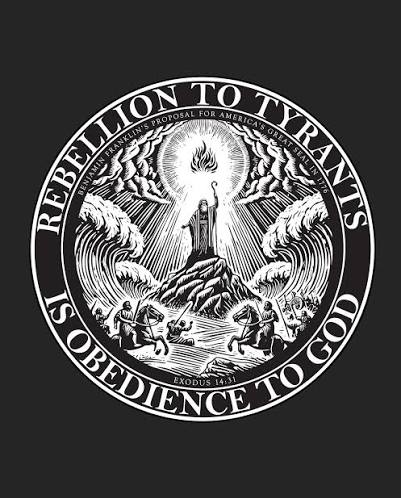
Benjamin Franklin looked elsewhere. His proposal portrayed Moses standing at the Red Sea while Pharaoh’s army disappeared beneath the waters. His proposed motto read, “Rebellion to tyrants is obedience to God.” At the birth of the American Republic, one of its greatest founders reached not first for Athens or Rome but for Exodus. The struggle against British tyranny was understood through the language of Israel’s liberation from Egypt. George III was not Pharaoh, and the Atlantic was not the Red Sea. Yet the moral grammar of liberty had become unmistakably biblical.
Thomas Jefferson likewise proposed a scene from the Hebrew Bible: the Israelites journeying through the wilderness, led by the pillar of cloud by day and the pillar of fire by night. On the reverse side, he paired this biblical image with Hengist and Horsa, legendary founders of Anglo-Saxon liberty. Jefferson instinctively combined two inheritances: biblical faith and English constitutional tradition.
Together, these proposals remind us that America did not emerge from a single intellectual tradition. It was born at the intersection of Athens and Jerusalem, classical republicanism and biblical morality, Enlightenment philosophy and covenantal theology. There were no Jews among the Founders, but Jewish ideas were undeniably among the founding ideas.
Historians have given this phenomenon a name: Political Hebraism. Beginning in the sixteenth century, European scholars increasingly turned to the Hebrew Bible to think about constitutional government, liberty, covenant, sovereignty, and the limits of political power. Many learned Hebrew to study Scripture in its original language. Some engaged rabbinic commentaries and Jewish interpretations of biblical law. They did not become Jews, nor did they seek to create a Jewish state. Yet the political imagination of ancient Israel profoundly influenced the development of modern constitutional thought.
That influence appears in some of the defining principles of the American experiment.
The first is covenant. The Constitution begins not with a monarch but with the words, “We the People.” Like the covenant at Sinai, legitimate political authority arises from a community freely binding itself together through mutual obligation and shared responsibility.
Second is the rule of law. In the ancient Near East, kings often stood above the law. The Torah proposed something revolutionary: even the king remained subject to God’s law. Deuteronomy commands the king to write a copy of the Torah and read it throughout his life so “that his heart may not be lifted above his brethren.” Power itself must be restrained. Authority remains accountable to something higher than itself.
Third is the principle of equal justice. Again and again, the Torah insists: “There shall be one law for the citizen and for the stranger.” Justice cannot depend upon birth, status, or privilege. The aspiration toward equality before the law is among Scripture’s most enduring political contributions.
Fourth is the belief in human dignity. The Declaration of Independence proclaims that all people are created equal and endowed by their Creator with certain inalienable rights. Long before Locke or Jefferson, Genesis declared that every human being is created b’tzelem Elohim—in the image of God. Human dignity does not originate with the state. The government exists to recognize and protect a dignity that already belongs to every person.
Fifth is the division of power. Biblical Israel separated the roles of king, priest, prophet, and judge. No single figure possessed unlimited authority. Judaism has always understood that unchecked power corrupts not because rulers are uniquely evil, but because all human beings are profoundly human. Limiting power is therefore not a sign of distrust alone but of wisdom.
Sixth is the prophetic conviction that power must always remain open to moral criticism. Isaiah, Jeremiah, Amos, and Micah stood before kings to proclaim that justice matters more than prestige, righteousness more than ceremony. Their voices remind every free society that patriotism is diminished, not strengthened, when criticism is silenced.
Finally, Jewish political thought insists that the government possesses a moral purpose beyond preserving order. Political institutions exist to protect human dignity, pursue justice, cultivate peace, and defend the vulnerable. The state is never an end in itself; it is an instrument through which a society seeks the common good.
Of course, recognizing these biblical influences is not to romanticize American history. The nation that proclaimed liberty tolerated slavery. The republic that affirmed equality often denied it in practice. Like every human endeavor, America has repeatedly fallen short of its highest ideals. Yet perhaps the greatest wisdom of the American founding lies precisely in acknowledging that reality.
The Constitution does not seek to establish a perfect union. Its aspiration is “to form a more perfect Union.” That single word—more—may be among the most profoundly Jewish words in American political thought.
It reflects a humility deeply embedded within our own tradition. Judaism has never imagined that individuals, communities, or nations achieve perfection in a single generation. Instead, we speak of teshuvah: the continual work of self-examination and growth. We speak of tikkun: repair. And ultimately, we speak of Tikkun Olam—not as the fantasy of creating a perfect world overnight, but as the patient, disciplined task of repairing what is broken, one act at a time.
A more perfect union is not built through sweeping declarations alone. It is built through small acts of honesty, justice, compassion, responsibility, and civic courage. It is built every time we choose dialogue over contempt, truth over convenience, service over self-interest, and hope over cynicism. Perfection remains beyond human reach; perfectibility remains our calling.
As America celebrates its fifth Jubilee, it is worth remembering that one of the most iconic symbols of American liberty already carries the language of the biblical Jubilee. The Liberty Bell is inscribed with the words of Leviticus: “Proclaim liberty throughout all the land unto all the inhabitants thereof.” In its original context, that verse announces the Shnat HaYovel, the Jubilee year: a radical biblical institution in which society is called to return to its beginning. Land reverts to its original families, debts are released, slaves go free, and the social order is given the possibility of a sacred reset. The Jubilee is not merely a celebration of time passed; it is a national act of moral self-examination. Every Jubilee asks a society whether it has remained faithful to its founding covenant or drifted away from its deepest values. It offers the courage to return—not nostalgically, but ethically—to the principles that first gave the community its purpose.
Perhaps that is the enduring gift Jewish wisdom can offer America at 250 years. Not the illusion that our work is complete, but the conviction that every generation must ask whether liberty still reaches “all the inhabitants thereof.” A more perfect Union is built through this ongoing work of return and repair: through teshuvah, through tikkun, through the humble discipline of improving what is broken one act, one institution, and one generation at a time. May this fifth Jubilee remind us that freedom is not only something we inherit; it is something we must renew. And may we dedicate ourselves, as Americans and as Jews, to making this country a little more just, a little more compassionate, and therefore, in the deepest sense of the Constitution’s promise, a more perfect Union.
Shabbat Shalom, and Happy Fourth of July.
Rabbi Uriel Romano
Broward Central Synagogue, FL